Portable Extra Small Windows Xp Usb Flash Edition Download
For a long time, Microsoft didn't sell Windows install media in the course of bootable USB flash drives. Instead, it prefered to stick to old-school DVD media, despite the fact that many notebooks today are besides small to even include an optical drive, and many DIYers are edifice PCs which forego ane on purpose.
However, things have moved on, and for the first time, Microsoft has begun to sell Windows x on pre-configured USB drives. Previous versions of the OS (XP, 7 and 8.1), all require the user to create their ain bootable USB drive.
Creating a bootable Windows USB drive used to be a chore, but today, one solution can pretty-well suit near people. However, there are times when a flash drive has some quirk that prevents it from working with a item solution, so for that reason, this article takes a look at five different methods.
Guide Index:
- USB Installer Tools & Successes
- Acquiring a Disc Image (ISO)
- Method 1 – Using Rufus
- Method 2 – UNetbootin
- Method 3 – Using Microsoft diskpart
- Method 4 – Microsoft Windows 7 USB/DVD Tool
- Method 5 – Windows 10 Media Creation Tool
- Windows XP Notes
- Common Problems
Benefits of USB Install Media
Fifty-fifty if the target desktop or notebook has an optical bulldoze, there are a couple of reasons to consider offset creating a USB-based installer. Absolutely, the time and endeavour of creating the drive might brand it best-suited for system builders, but for people like u.s., who juggle exam machines, USB is a no-brainer.
To start, USB media is more durable than disc-based media. Discs can be easily scratched, while well-built USB wink drives can generally handle a bit of abuse. Then, there'due south the convenience. Ever walk around with a disc in your pocket? It looks a bit odd.
For us, performance and reliability are the key reasons why we've opted to use USB-based installers in lieu of discs, especially with USB 3.0 being much more than mutual. Even if a DVD has been burned at the highest commercial speeds, information technology won't exist able to compete with flash memory which offers far improved IOPS operation (operations per second) – it's the same reason why SSDs are much faster for booting an Bone and loading applications than a mechanical hard drive; the seek times are minuscule in comparing.
While it's beyond the scope of this article, those who truly want a fast install experience can slipstream USB 3.0 support into the install media, which on current chipsets and an SSD target tin can allow you to install Windows in under iv minutes flat.
USB Installer Tools & Successes
Over the course of this article, we're going to be looking at five different solutions that accomplish the exact same thing: Creating a USB-based Windows installer; if one doesn't work, the adjacent 1 should (at least, that's the hope). To give an overview of what to look from each solution, refer to this success table:
| Windows ten | Windows 8 | Windows seven | Windows XP | |
| Rufus | Yes* | Yep | Yes | Yes |
| UNetbootin | Yes | Yes | Yes | No |
| diskpart | Yes | Yes | Yes | No |
| Microsoft USB Tool | Yes | Yes | Yes | No |
| Media Creation Tool | Yes | No | No | No |
| * Requires Rufus 2.1.6 or later. | ||||
Given the fact that Windows XP has reached end-of-life status and doesn't officially back up installation over USB, we take to outline a number of bug and conditions in order to get it working. Windows XP over USB is notwithstanding temperamental, and there is a good hazard that information technology merely won't work with your system, then please keep this in mind.
For starters, modern UEFI-equipped machines are not designed to support such an old OS, so chances are that it will not even install, or even be detected in the first place. If the motherboard in question happens to back up a legacy BIOS style, then it might piece of work. Different version of Rufus (explained after) take better luck with the XP procedure than others. We strongly propose you skip to the defended part of this commodity that explains the problems with Windows XP and USB support.
What about Windows Vista? Like Windows 7, 8, and 10, Vista too tin can be installed from USB media with these aforementioned methods, but due to that fact that most have moved on from it in favor of 10, it's not a big focus.
We mentioned Rufus higher up, and that's the tool we're going to lead in here with, every bit nosotros consider it to be the simplest to use, and the most effective. We discussed the aforementioned tool in an article from summer 2012 called 'Creating a Bootable DOS Flash Bulldoze the Easy Way', as information technology allows for simple creation of bootable MS-DOS flash drives, as the title suggests.
Afterward the wait at Rufus, nosotros'll continue on to UNetbootin, Microsoft's diskpart (a tool built into Windows), a quick mention of another official Microsoft tool, but 1 the company no longer promotes for Windows 7 and 8, as well as the latest method, the Media Creation Tool. But starting time…
Acquiring a Disc Image (ISO)
Some solutions listed on this page crave a Windows disc prototype (.iso) to be present. The exception is 'diskpart', every bit the disc's files will need to be transferred over manually (information technology doesn't affair if they come from a mounted ISO or a drive in an actual DVD-ROM). ISOs are available from a number of sources, but most people will larn them after purchasing the OS online through Microsoft, or through some other related Microsoft service. If you don't take an ISO, or a disc for that matter, you'll demand to acquire ane from a friend or elsewhere on the spider web.
If yous're just looking to downloadWindows 10 as an ISO, you simply need to run the tool listed in pace #5, and choose to save as ISO rather than to fire the image to a flash bulldoze. Notation that we can't actually provide an MD5 for a Windows ten ISO, as it changes every fourth dimension it's downloaded through Microsoft'south tool. Only the ISOs directly supplied by Microsoft would have static hashes.
At that place are multiple editions of whatsoever given Windows version, but we're going to listing the exact ISOs we used along with their MD5 checksums in case they prove useful.
MD5 Checksums
- Windows XP Pro (Service Pack three): F424A52153E6E5ED4C0D44235CF545D5
- Windows 7 Ultimate (Service Pack ane): 56A26636EC667799F5A7F42F142C772D
- Windows 8 Pro: 0E8F2199FAE18FE510C23426E68F675A
- Windows viii.ane (MSDN; multi-version): CDADC5A76634651770A365F457702803
Delight be careful where you source your OS image from, as most online sources will be pirated copies and/or bundled with extra (sometimes malicious) software. How the image was captured every bit well volition have an effect on how the final boot drive turns out, then stick to official sources where possible.
For those who have a Windows setup DVD, a complimentary tool like CDBurnerXP or ImgBurn can be used to rip it into an .iso file. Other tools exist that accomplish the same thing, but these are the only ones nosotros can personally recommend. For mounting an ISO image, we'd recommend Virtual CloneDrive, every bit it's free, and not the "free only a total nag" kind of gratuitous.
Annotation: Some anti-virus applications might interfere with the USB creation process due to the autorun properties involved, so if issues are experienced, we'd recommend temporarily disabling the anti-virus until the process is complete.
Using Rufus
Both Rufus and UNetbootin are elementary tools for this job, and outside of Rufus' Windows XP support, both work just the same. However, we adopt Rufus considering we find it loads a lot quicker, and feels a bit faster, too. For a cracking many reasons, this is however our preferred method of creating USB boot drives.
With Rufus loaded upwardly, choose the advisable device that you want to turn into a boot drive, nether the "Device" menu, and make sure that the file organization is NTFS (non FAT32). The other options shouldn't thing too much, although if yous're planning to install Windows 8 equally an official EFI OS, you may wish to peruse the options nether the "Partition scheme and target organization type" menu. For Windows XP, select MBR Sectionalisation only.
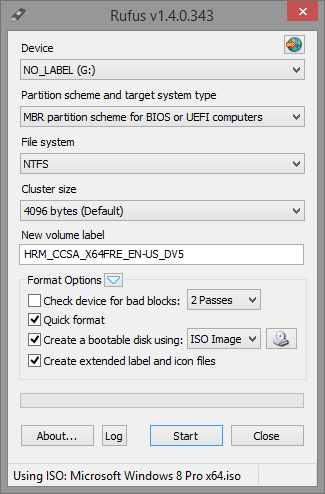
To load the Windows .iso file, the minor CD icon to the correct of "Create a bootable deejay using:" option can be clicked. Subsequently perusing the file manager for the ISO image and accepting it, the "Start" button can be clicked to have the tool work its magic. Notation: Equally the program will state, doing this volition erase all data off of the flash bulldoze – so backup first.
If you have whatsoever issues, be certain to check out our Common Issues section beneath.
Using UNetbootin
UNetbootin is a well-known tool as it's become a de facto choice for turning a bootable Linux live CD into a bootable Linux live flash drive – for that purpose, it still excels. Little do almost people realize, it can handle Windows ISOs as well (just every bit the table at the top of this folio shows, information technology doesn't support creating a bootable Windows XP drive).
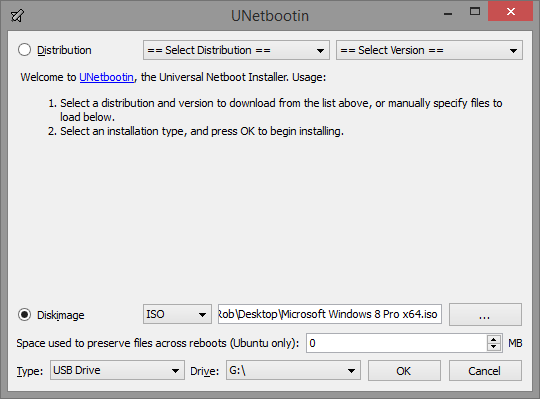
Similar with Rufus, the advisable drive should be selected from the "Drive:" menu at the bottom, and so the "…" push button to the right of the largest text field tin can be clicked to search for and accept the required ISO. At this bespeak, the "OK" tin can exist clicked, and the process will get underway.
Different Rufus, UNetbootin doesn't erase the wink bulldoze first, so information remains intact – withal, if you're repeatedly writing new ISOs to the drive using the tool, it's recommended you format later each one, so as to not get out unused chip files around the drive. NOTE: We'd withal recommend backing up personal data before writing an ISO to it merely in example.
Using Microsoft diskpart
For those who don't have an ISO, merely rather a DVD, diskpart is the solution for yous. It does require some command-line usage, simply equally y'all'll come across, it's not too complicated. NOTE: This method will delete the entire flash drive, and then be certain to support personal data first.
To brand proper use of diskpart, you'll need to open up a command prompt with administrator rights (head to "Start", type in 'cmd', right-click it, and choose 'Open as Ambassador'). Once the prompt is opened, blazon in 'diskpart' to load the tool, and and then 'listing disk' to figure out which # relates to your flash drive.
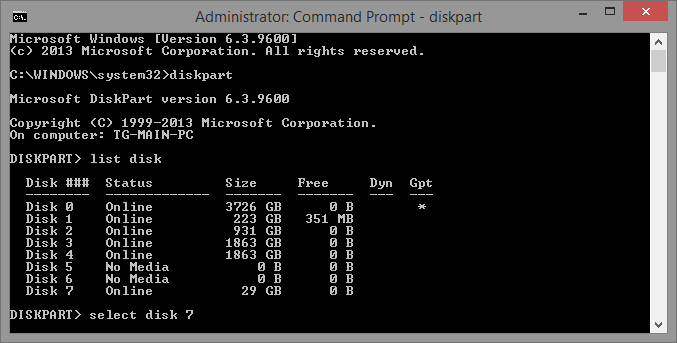
External storage should appear at the end of the list, and in our case, it did (we're using a 32GB wink drive, which appears here as 29GB). Once the appropriate drive is figured-out, it can exist called using the 'select deejay #' command. One time selected, it needs to be wiped clean, have a partitioning created, and then be formatted. The entire command process is summed-up in this block:
list deejay – shows avaialble disks, look advisedly for the one that looks like your flash drive
select disk # – modify # to the disk (flash drive) you wish to employ
clean – removes existing partions
create sectionalisation chief
select partition one
active
format fs=ntfs quick
assign
exit
For those who might want to see this in activeness, we provide this screenshot:
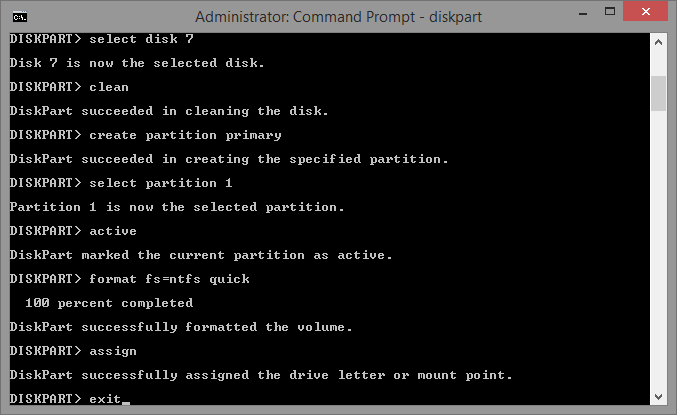
Notation that "quick" tin exist removed off of the format command to run a full format, but that might accept minutes to tens of minutes depending on the bulldoze (every bit it's more thorough).
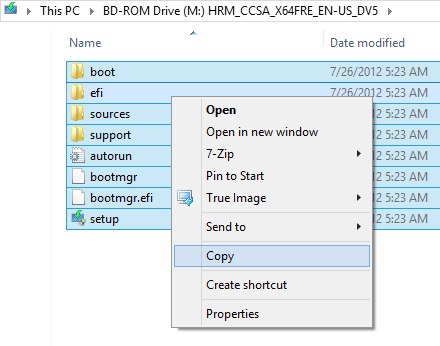
At this signal, the Windows setup DVD can exist inserted into the drive, or the ISO mounted, and its files copied over to the root binder of the flash bulldoze. After the process is done, opening upwardly the flash drive in the file director should mirror the contents of the Windows DVD/ISO.
Using Microsoft Windows 7 USB/DVD Tool
After the Windows 7 launch, Microsoft released its own USB creator tool that supported its official ISOs. While the visitor no longer promotes the tool, information technology supports at to the lowest degree seven and eight just fine, so some might adopt to use it over the other solutions.
In one case downloaded and opened, an ISO must be chosen. After that, the "USB Device" option needs to be clicked (this same tool tin also burn down straight to a DVD).
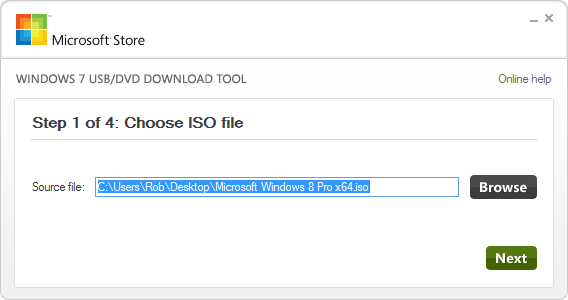
At the concluding screen, the appropriate flash dive needs to be selected from the menu, and afterward hitting "Begin copying", the entire process volition exist complete after simply a couple of minutes.
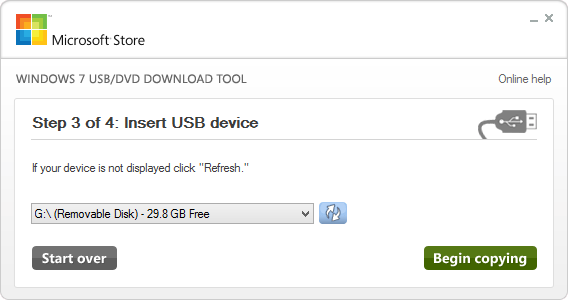
Truthfully, Microsoft's tool hither might be the easiest of them all to use, but because the company isn't promoting it in whatever way, shape, or form (notation that information technology'due south called the Windows seven USB/DVD tool, and not Windows 7 & 8 USB/DVD tool), we feel that information technology's right to quicker recommend the other (often updated) solutions first.
Using Windows 10 Media Creation Tool
If you lot plan to install Windows 10 on a new system, utilise it to recover an existing system, or upgrade a previous install of Windows 7 or 8, creating a bootable flash drive is the first step. Windows 10 is the first Microsoft Bone that non only natively supports USB installs, but encourages it and even sells USB drives set-to-go.
The process with Windows ten is not much unlike from Windows 7 and viii/eight.1 like above, simply is made simpler past the fact that yous don't even need the deejay image offset, as you can download information technology directly from Microsoft, consummate with all the latest service packs already installed.
The whole process for creating a Windows ten bootable USB bulldoze can be done by using the Media Creation Tool; most systems these days volition employ the 64-bit version, then grab that.
Once you've downloaded the tool, run it and y'all'll be presented with the media creation process. The gallery below outlines each stride of the process for the basic method. At that place are a few things you lot might need to check starting time. Depending on where y'all plan to install Windows 10, yous need to check which version you require, Habitation or Pro. Annotation: The contents of the USB flash drive volition exist erased, so make sure you back it up first.
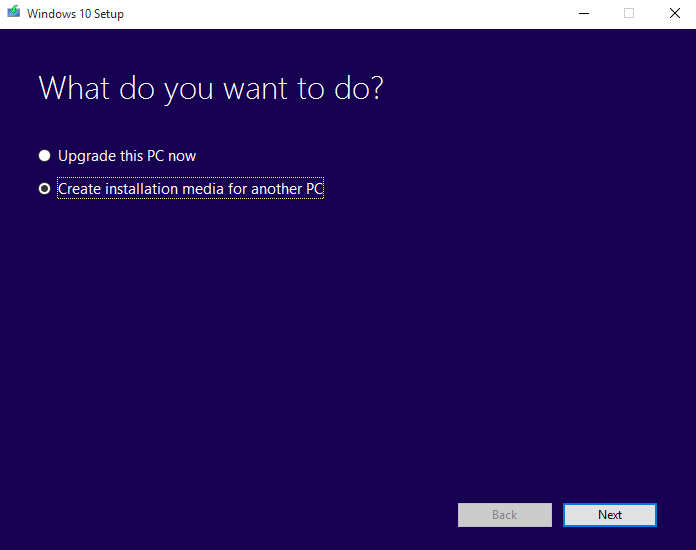
Select 'Create installation media for some other PC' to begin the process.

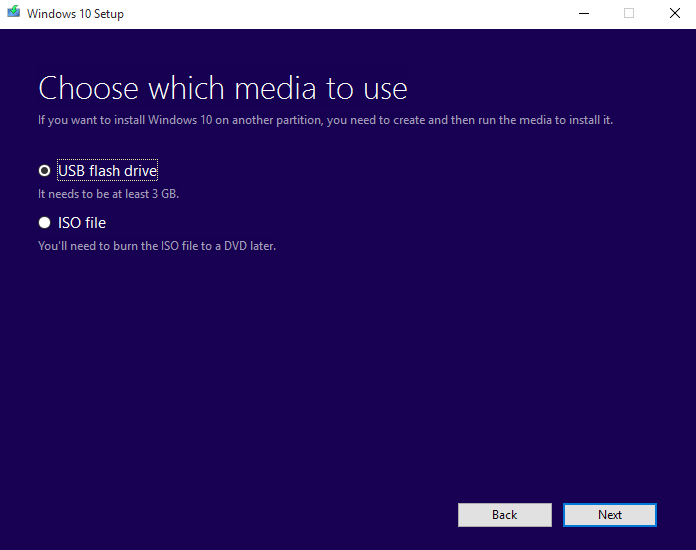
We'll be creating the bootable USB wink drive with the tool, so select the first option.
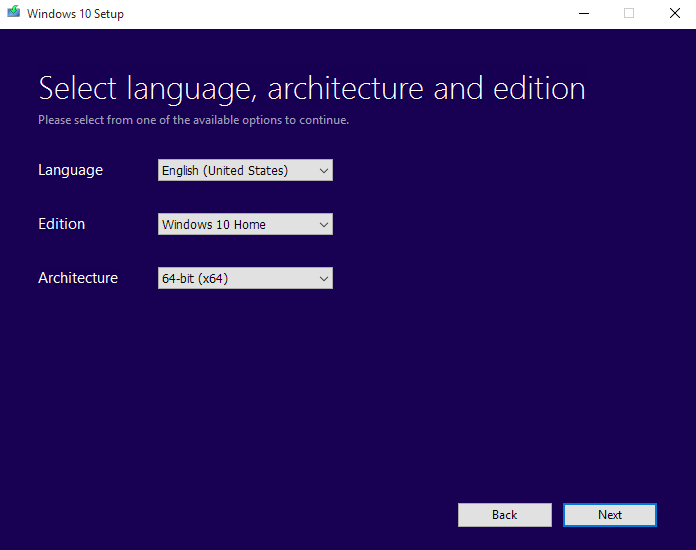
Select the version of Windows 10 that you crave, in this case, we went with Domicile 64-scrap.


Choose the USB drive that you lot wish to turn into the bootable media. Just Wink media will show on the list. The drive will demand at least 4GB of free infinite. NOTE: The flash drive will be formatted, and then make backups first.

Expect for the tool to end downloading. Depending on your Cyberspace connection, this could be from a few minutes to a few hours.

One time the Windows ten prototype has downloaded, it will automatically brainstorm creating the kick media on the bulldoze you lot selected. This tin can take a few minutes.
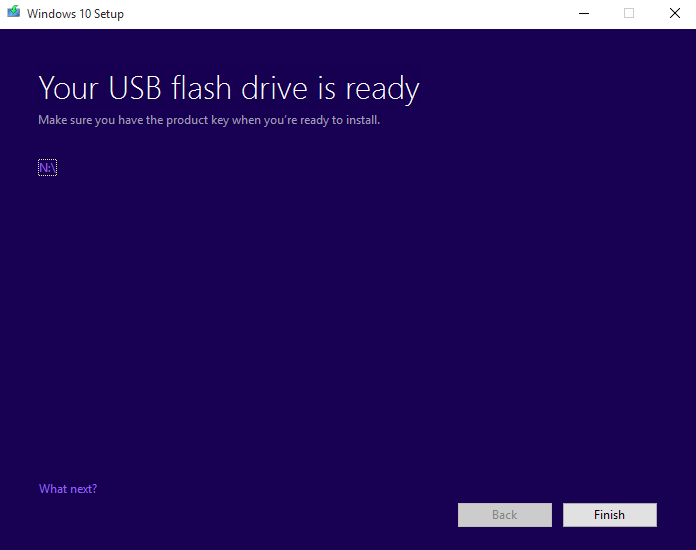
If everything when co-ordinate to plan, the Media Creation Tool will declare success and you are ready to use your new Windows x bootable USB drive.
The version yous option here at the beginning really doesn't matter, since your license key will decide the version you can utilise, and the Bone will change and configure itself based on that key. The Due north version of each Os type is for the EU compliant version, but truth be told, there isn't annihilation dissimilar nigh information technology at this time. You can choice 64-fleck every bit well, or both 32/64-fleck if yous are unsure or plan on using the bootable flash bulldoze on different systems.
The Media Creation Tool can can exist used to merely download the ISO epitome of Windows x, which tin can so be used with something like Rufus to create the bootable USB drive. This offers the advantage of beingness able to keep a fill-in of the ISO image, equally well as create multiple boot drives without having to download the prototype each fourth dimension. If you run into problems with the Media Cosmos Tool when it comes to creating the bootable wink drive, you tin can use the following method.
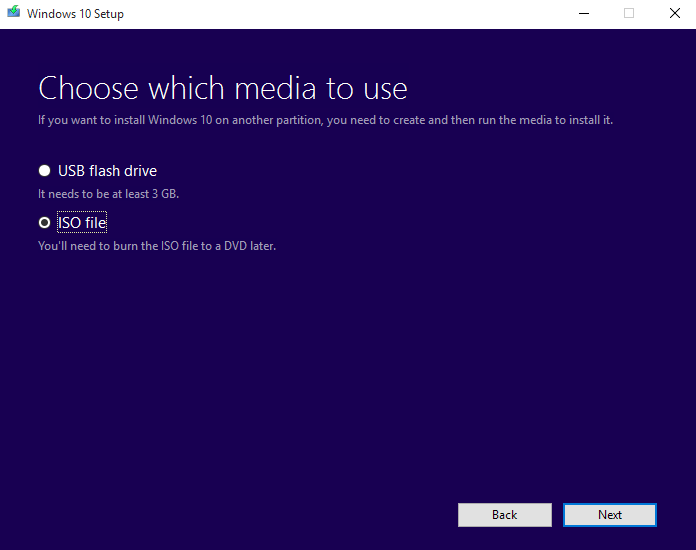
Instead of selecting USB Flash Drive in the Media Creation Tool, just select ISO File instead, choose a location to save the file, and afterward it'south downloaded, follow the steps outlined in the Rufus guide above. In general, we found this method more than reliable than using the Media Creation Tool to create the Windows 10 bootable wink drive, and ther are a number of other advantages to using Rufus equally well.
Notation: When you permit the Media Creation Tool handle the unabridged procedure of making the USB kick drive, there is a small problem when dealing with USB drives larger than 32GB. The tool will only create a single partition up to 32GB and then completely ignore the rest of the drive, and Windows-based operating systems can only handle a single partition on USB flash drives. If you create the kicking bulldoze with Rufus, information technology'll employ the unabridged drive, so 64GB and 128GB flash drives will have the total disk space made available.
Windows XP Notes
If you are attempting to apply Windows XP on a USB drive, there are a couple of things to deport in mind. First off, nosotros strongly recommend using Rufus (32-chip version) to setup XP on a USB flash drive over the other methods, every bit its success rate is much ameliorate. If installing with Rufus doesn't work the get-go time, change the partition mode to MBR for BIOS simply. Making XP boot over USB is a little tricky as well, because it's much more sensitive to the historic period of the hardware and the system yous are using it with.
As far as we know, the 32-bit ISO image of XP is the only compatible version that tin can exist put on a bootable flash drive (success for XP 64-bit was limited). 1 of the key points though is that you tin't use a USB 3.0 port when installing, even with EHCI mode enabled. Nosotros besides found that a lot of modern hardware refuses to find the bulldoze.
If you are using an older organisation, so you lot should take better luck booting Windows XP from a USB flash bulldoze. Just be sure that your particular motherboard supports booting from USB in the start place (it's unremarkably off by default in older system). Check the BIOS boot section and see if USB drives are supported.
Unfortunately, the time period in which motherboards supported USB booting on older hardware is quite short, as annihilation before didn't take the option, and annihilation subsequently (around the time Windows Vista and vii took off), those boards started the transition over to UEFI, which XP does non support.
A number of systems we have tested this with had very mixed results. Both an older Pentium D system with BIOS, and a i7-2600 with UEFI, couldn't boot into XP. The USB media does piece of work on a couple of laptops, simply with other systems, it merely boots up into a blank screen. If checking your motherboard settings for USB boot back up and even legacy modes do not work, then you will have to resort to using a CD/DVD. You tin can read beneath for some more general advice as well.
Common Problems
No Bootable Device Detected
This tin be caused by a number of things. The near common is that your system is non setup to observe or boot from USB devices. You will need to go into your BIOS/EFI and check whether your USB drive is detected at all. If it is, make sure that it's available from the boot menu. If it isn't, so some security option may be enabled that prevents booting from USB devices.
As each BIOS/EFI is different, nosotros can non assist with specific options, but check diverse security and boot menus to make sure that USB back up is enabled. If everything appears correct, but yet can't be detected, try enabling USB legacy support, or a different USB port, such every bit a USB 2.0 port instead of USB iii.0.
It's too possible that the install media, or ISO epitome yous take, does not take the boot data available. Try a different ISO paradigm if at all possible.
Windows Installer Starts Just Can't Find Install Media
If the installer starts and lets y'all pick installation options, only an mistake occurs that either says it can't find the DVD or it requests yous to insert media with boosted drivers, and so yous need to utilize a USB 2.0 port.
Windows XP, Vista and 7, do non have native back up for USB 3.0 ports. Attempting to install with your flash bulldoze plugged into a USB 3.0 port will effect in the above error. Unplug your USB Flash Bulldoze and insert it into a USB ii.0 port, so brainstorm the process once more. You may all the same use a USB 3.0 Flash drive, but non plugged into a USB 3.0 port.
If no USB 2.0 ports are available (such as with more modern systems), then y'all will either need to go into the BIOS/EFI and enable forced legacy mode or enable EHCI on the USB ports, or you volition need to 'slipstream' the USB iii.0 drivers into your Windows Install Image.
Wink Drive Isn't Using All Bachelor Infinite
This was mentioned previously in the Windows 10 section, but if you are creating a USB boot drive for Windows 10 and your 64GB drive is only showing 32GB available, and then you need to recreate your boot drive with Rufus. The Media Creation Tool (MCT) only supports drives upward to 32GB, and annihilation larger will have a second partition made, which Windows can not detect ordinarily (but is still available if you plug it into a Linux machine for case). Then download the ISO with MCT, then wink it with Rufus.
Windows 10 'Something Happened'
Generic and oh-so-helpful fault. If you are using the Media Cosmos Tool to create the bootable USB flash bulldoze, and information technology'due south failing on the terminal pace, try the alternative (and recommended) method of using the tool to download the ISO paradigm and and so apply Rufus to create the boot media. If the Media Creation Tool is declining to download the ISO, then this is probable a network upshot with either your local machine or Microsoft'southward server. Endeavor using a wired/Ethernet connection instead of wireless, or just wait a while and try once more later. Declining that, try to download from a different machine if possible.
If y'all take any questions about any of the steps, delight leave a annotate below and we'll assist y'all as best we tin can.
Update: This article was updated May 2018 past Jamie Fletcher, to include Windows 10 and additional information regarding XP and USB size issues. Originally published Dec 2013.
Support our efforts! With advertisement acquirement at an all-fourth dimension low for written websites, we're relying more than e'er on reader support to assistance us proceed putting and so much effort into this type of content. You lot can support us by becoming a Patron, or by using our Amazon shopping affiliate links listed through our articles. Thanks for your support!
DOWNLOAD HERE
Posted by: clarkeloctatintoo.blogspot.com
Post a Comment